PRESS RELEASE
Slovenian Technology Forum: Slovenia's Development Challenges - Slovenia 2040 - A smart government will listen to us. The pre-election period is no time for reckless actions or empty promises.
Ljubljana, 18 September 2025 - The Slovenian Technology Forum (STF) hosted a discussion today at the Cankar Hall Club titled “Development Challenges of Slovenia - Slovenia 2040 - A Conversation with Politicians,” where key development challenges and priorities for Slovenia's future were presented to political parties, business representatives, and experts.
The event was moderated by economic journalist Nejc Gole (Delo),Opening remarks were provided by Andraž Logar, President of the STF Management Board, and Barbara Krajnc, Director of the STF,who emphasized the importance of dialogue between politics and the economy, as well as the need for bold steps to achieve a real breakthrough in Slovenia's development.
One of the key takeaways from the political party representatives was that a culture of dissent-or even resistance-prevails in Slovenia, particularly among politicians and within society at large. In contrast, despite the politically diverse panel of speakers, there was a consensus that it is high time for politicians to unite on the most critical social issues and move from words to action, as there is no more time for inaction.
At the STF, we recognize that we are in a pre-election period, which is no time for ad hoc, reckless measures-such as mandatory Christmas bonuses or further modifications to the tax system for sole proprietors-and we strongly oppose such proposals.
Political speakers
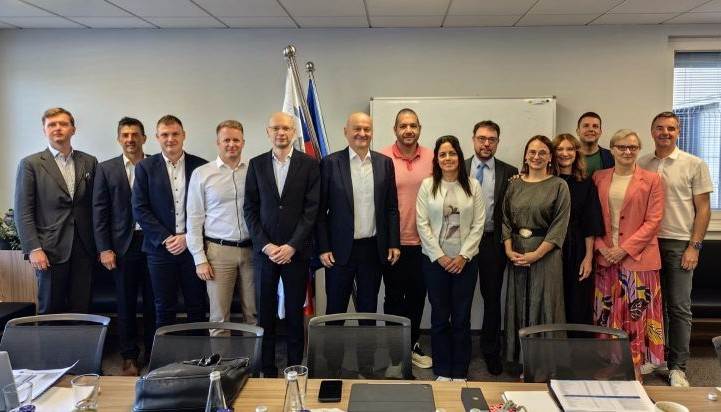
The following representatives of various political parties and institutions participated in the discussion: Aleksander Prosen Kralj, Member of the National Assembly, Freedom Movement, Matevž Frangež, State Secretary at the Ministry of the Economy, Tourism and Sport, Social Democrats, Rado Gladek, Member of the SDS, Josef Horvat, Member of New Slovenia - Christian Democrats, Jan Dobrilovic, the Democrats and Marko Lotric, President of the National Council and leader of the Fokus Party. The special guest of the event was Peter Wostner (IMAD), editor of the Development Report, who provided expert analysis and international comparisons to the discussion.
The next government, if it is smart, will listen to you. - comment by Jožef Horvat, NSi MP
Key topics of discussion
The discussion was divided into several substantive sections:
Tax environment and labour market - Participants discussed the excessive tax burden on wages, the challenges of the income tax system regarding middle-class taxation, the system for self-employed individuals, other forms of employee compensation, and the need for more competitive tax schemes to attract talent and reduce the brain drain of highly educated personnel. Conversely, most party representatives agreed that property taxation is a potential source of revenue.
• The tax system requires simplification; it needs to be transparent, straightforward, and clear to prevent the exploitation of loopholes or tax avoidance.
• When discussing taxes, the solution is not always to simply raise them. We need a social contract that makes it unequivocally clear how much the country costs us and what we receive in return.
• Particular attention was paid to instances of poor practice in the employment of foreign workers and the urgent need to simplify administrative procedures.
Digitalization and public administrationThe debate highlighted the need for a faster digital transformation of public services, the removal of administrative barriers, and a more integrated, user-friendly e-government. “The system is becoming increasingly complex for citizens. In practice, it is becoming useless and ineffective.”
Education and future competenciesSpeakers also touched on the need to overhaul the school system, integrate artificial intelligence, digital and various forms of literacy, and strengthen creativity and critical thinking among young people. 'Teachers need to be put back on a pedestal.'
Conclusion
The event showed that there is a broad consensus that a major development breakthrough is necessary for “Slovenia 2040”, which will require the participation of politics, the economy, science, and the wider society. We have a legal system based on mistrust that is too complicated, changes too often, and is incomprehensible to many.
The biggest challenge for all, however, is and will be to shift the entire mentality of society by 180 degrees and turn it in the direction of cooperation, transcending narrow and short-term political interests. The Slovenian Technology Forum will continue to bring together key players and promote dialogue on concrete actions for a future in which Slovenia will be among the most innovative and competitive countries.